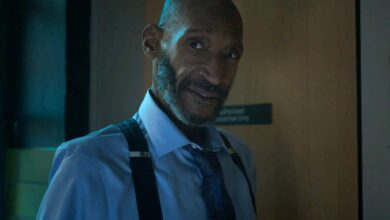

“Dead Mail” may start as a postal oddity, a slow-burn tribute to the unsung heroes of lost letters but it mutates into something far stranger, sadder, and ultimately more disturbing. Co-directed by Joe DeBoer and Kyle McConaghy, this Shudder original lands in the sweet spot between lo-fi procedural thriller and psychological horror. It opens with a haunting image: a man crawling through gravel, bloodied and desperate, shoving a plea for help into a mailbox before he’s dragged back into the shadows. Then, unexpectedly, we’re at the post office, following Jasper (Tomas Boykin), a dead-letter detective whose analog investigations are as compelling as any detective noir.
The film thrives in its first and third acts when it’s immersed in the rhythms of Jasper’s world, a place of mystery, rain-drenched letters, and dusty atlases. Boykin’s performance is quiet but captivating, like a man haunted by the mail he can’t deliver. But the film shifts dramatically when it leaves him behind and dives into the story of Josh (Sterling Macer Jr.), a soft-spoken synth engineer, and Trent (John Fleck), his obsessive patron turned captor. Their dynamic, built around woodwind sounds and isolation, is twisted and fascinating, though it drags in stretches.
Fleck and Macer are excellent in roles that oscillate between pitiful and terrifying, and the filmmakers don’t shy away from implications about race, repressed desire, and creative obsession. Whether those implications land is another question, Dead Mail prefers eerie vibes and elliptical storytelling over clarity. Its 1980s setting is more than aesthetic; it’s existential. Wood paneling, synth pulses, and forgotten corners of the Midwest give the film the texture of a fading memory.
It’s uneven, but by the time Dead Mail loops back to its haunting opener, it casts a spell that’s hard to shake. Maybe the post office really is haunted by the stories we never got to tell.
Much of the film’s strange magic lies in how ordinary it insists on being. This isn’t a horror movie about demonic possession or jump scares, it’s about the systems and people we overlook, the kind of men who know the barometric pressure in Arkansas in 1983 or how to decode a smudged ZIP code by font spacing. Jasper’s slow-burning side of the story holds a strange, analog tension that’s hard to shake, as if the entire film is tuned to the hiss of fluorescent lights and the click of a filing cabinet drawer. It’s procedural, sure, but there’s something intimate and eerie about watching someone uncover horror one clue at a time with nothing but a rotary phone and some microfiche.
And yet, the film falters slightly in its pivot from postal intrigue to psychological captivity. While the back half carries emotional and thematic weight, it loses some of the grounded charm and novelty that made the first act so fascinating. The tonal shift into obsession and loneliness works, especially thanks to John Fleck’s twitchy performance as Trent, but the pacing drags in places and some of the more bizarre narrative turns feel like they’re building toward something more profound than what’s ultimately delivered. Still, there’s no denying Dead Mail is a singular piece of work, one that lingers like a weird letter you’re not sure how to read, but you can’t quite throw away.
3.5/5 Stars